
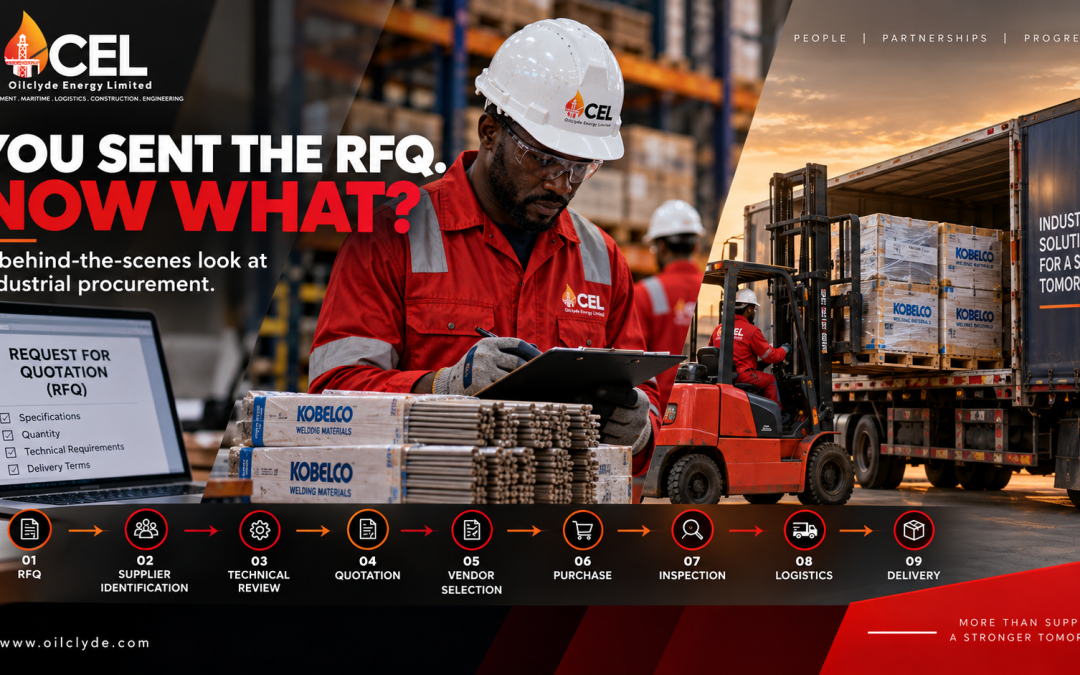
You send an RFQ. Then what? From the outside, industrial procurement can look simple.
A company needs equipment.
The procurement team sends a Request for Quotation (RFQ).
Suppliers submit prices.
Someone chooses the best offer.
The equipment is delivered.
But anyone who has worked around oil & gas, power, construction, engineering or other industrial projects knows that the real work begins after the RFQ leaves your inbox.
Because an RFQ is not the end of the procurement process.
It is the beginning of a chain of decisions that eventually determines whether the right equipment gets to the right place, at the right time, and to the required standard.
The Chartered Institute of Procurement & Supply (CIPS) describes procurement as a cycle that extends from defining a business need and specification through sourcing, tendering, delivery, supplier performance and asset management.
For industrial procurement, that distinction matters.Because a quotation can look good on paper and still become an expensive problem later. So, what actually happens after you send an RFQ?
Let’s follow the journey.
What Is an RFQ?
An RFQ, or Request for Quotation, is a formal request for suppliers to provide pricing and other relevant information for specified goods or services.
In a proper procurement process, the request is connected to a defined business need, technical specification, delivery requirement, commercial terms and evaluation criteria.
CIPS places specification and understanding the business need at the beginning of the procurement cycle, while its tender guidance describes the RFQ as part of a structured process involving supplier selection, tender documentation, evaluation and contract award.
And that brings us to what happens after the RFQ is submitted.
1. The Requirement Is Reviewed
Before anyone starts comparing prices, the requirement has to be understood. The following questions must be answered.
- What exactly is being requested?
- What specification must the equipment meet?
- What quantity is required?
- Where is it going?
- What operating conditions will it face?
- Are there applicable standards, certifications or documentation requirements?
- What is the required delivery timeline?
These questions matter because the quality of the procurement outcome depends heavily on the quality of the requirement being communicated.
A vague requirement can produce several quotations that appear comparable but are actually offering different things.This is why procurement and technical teams often need to work together before a supplier is selected.
2. The Right Suppliers Are Identified
Once the requirement is clear, the next question becomes:
Who can actually supply it?
This is where supplier identification and market knowledge become important. The objective is not simply to find a supplier. It is to find suppliers with the right combination of:
- Technical capability
- Product availability
- Capacity
- Relevant certifications
- Delivery capability
- Financial strength
- Industry experience
- Reliability
- Geographic reach
- Compliance requirements
CIPS identifies supplier evaluation and selection as a fundamental part of procurement, with considerations including capability, capacity, technical competence and financial strength.
For specialised industrial equipment, this step can be particularly important.
The question goes beyond “Who sells this equipment?” to:
“Who can supply the correct equipment, from a credible source, with the documentation, technical support and delivery capability the project requires?”
That is a very different question.
3. The Technical Requirements Are Checked
Now we get to one of the most important parts of industrial equipment procurement.
Technical evaluation.
A quotation can have an attractive price and still fail the requirement. This is because the equipment may have the wrong capacity. The specification may not match the application. The proposed alternative may not be acceptable. The supplier may not have the necessary certifications. Or critical accessories, spares or supporting components may not be included.
This is why technical evaluation should not be treated as a box-ticking exercise.
CIPS recommends technical assessment of supplier submissions alongside financial and capacity assessments. The World Bank’s procurement guidance similarly recognises quality, methodology, risk, performance and capacity as factors that can matter alongside price.
For industrial procurement, the question should always be:
Will this equipment actually perform the job it is being procured to do?
4. The Quotations Are Evaluated
Now the quotations start to tell a bigger story. The price of an equipment does not tell you which quotation represents the best value. Let’s consider two suppliers.
Supplier A quotes ₦X. Supplier B quotes ₦X + 15%. At first glance, Supplier A appears to have won. But then you look closer.
Supplier A has:
- A longer lead time
- Fewer included accessories
- Limited technical support
- Higher freight costs
- No local technical support
- A weaker warranty arrangement
Supplier B includes more of what the project actually needs and can deliver sooner. Suddenly, the 15% difference looks very different. This is why procurement teams evaluate more than price.
CIPS notes that tender evaluation can include financial, technical and capacity assessments, as well as considerations such as whole-life costs.
The World Bank’s procurement framework makes a similar point through its use of non-price or “rated” criteria, which can consider quality, risk management, performance and capacity, health and safety, sustainability and past performance.
Know this today, the cheapest quotation is not automatically the best procurement decision.
The better question is:
Which option provides the best fit, value and ability to deliver the requirement?
5. The Supplier Is Selected
After technical and commercial evaluation, a supplier is selected. The selected supplier should be capable of fulfilling the obligation. Can they deliver? Can they meet the specification? Do they have the required capacity? Can they meet the project timeline? Are their certifications and documentation in order? Have they demonstrated reliable performance?
For larger or higher-risk procurements, supplier evaluation may involve more detailed checks, including documentation reviews, financial assessments, technical assessments and even site visits.
In Nigeria’s oil and gas industry, procurement and tendering can also involve specific Nigerian Content requirements. NCDMB’s project certification process, for example, includes stages covering technical ITTs, commercial ITTs, technical evaluation, commercial evaluation and Nigerian Content compliance.
That means the supplier selection stage can involve considerably more than comparing three price sheets.
6. The Purchase Is Confirmed
Once the supplier is selected, the procurement moves into contracting and execution.
Purchase orders, contracts, commercial terms, delivery schedules, payment terms, warranties and other obligations now become important. This is where the procurement process starts moving from selection to execution. And this is an important distinction.
The World Bank’s procurement framework treats contract implementation and management as a distinct part of the procurement journey, including monitoring obligations, performance and payment.
The focus now shifts to:
Can the agreed requirement actually be delivered as promised?
7. The Equipment Is Inspected and Prepared
This is where procurement becomes very physical. Equipment has to be sourced, received, checked and prepared for its next destination.Depending on the equipment and project requirements, this may involve checking:
- Quantity
- Model and specifications
- Serial numbers
- Physical condition
- Documentation
- Certifications
- Accessories
- Packaging
- Compliance with the purchase requirement
For specialised equipment, the details matter. The objective is simple:
Don’t discover a procurement problem for the first time when the equipment is already on site.
8. Logistics and Delivery Are Coordinated
Now the equipment has to move. And this is another stage where a seemingly straightforward procurement can become complicated.Where is the equipment coming from? Where is it going? What transportation method is appropriate? What handling requirements apply? Does the equipment require special packaging or securing? What documentation is required? Are there customs, port, marine or regulatory considerations? What is the delivery schedule? Who is responsible for receiving it?
CIPS includes warehouse, logistics and receipt within the procurement and supply cycle, reinforcing the fact that procurement does not end when a supplier is selected.
For industrial projects, delivery is part of the procurement outcome.
If the equipment is technically correct but arrives late, damaged or incomplete, the procurement has not achieved its purpose.
9. The Equipment Reaches Site
Finally, the equipment arrives. But even here, there is still a handover. The delivered equipment needs to correspond with what was ordered. The required documentation needs to be available. The receiving team needs to be able to confirm what has arrived.
And where applicable, the equipment may need further inspection, installation, commissioning or technical support. Only then does the procurement journey begin to close.
And the lesson is worth repeating:
The purchase order is not the finish line. Delivery is not even necessarily the finish line. The real objective is fulfilling the business need that triggered the procurement in the first place.
Need equipment or procurement support?
Have an equipment requirement, RFQ or sourcing challenge?
Send Oilclyde your RFQ @procurement@oilclydegroup.com
Let’s move it from requirement to delivery. Also follow us on LinkedIn, Facebook and Instagram @Oilclyde Energy Limited.
Recent Comments